AI Psycholinguistic Analysis: Hyper-Personalized Content by Solustiq (2026)
Success in the digital world comes from understanding the user and offering tailored experiences. Therefore, AI psycholinguistic analysis is one of the key technologies that elevates this understanding to the next level. As of 2026, at Solustiq, the websites we develop aim to understand user behavior not only by "what" they say, but also "how" and "why" they say it, using these advanced analytical methods. Through these in-depth analyses, we enable websites to establish more meaningful and personalized interactions with their visitors. This innovative approach revolutionizes digital engagement, driven by powerful AI psycholinguistic analysis.
What is AI Psycholinguistic Analysis and Its Importance?
AI psycholinguistic analysis refers to an advanced field that combines linguistic and psychological principles. This method focuses on making inferences about the speaker's or writer's emotional state, personality traits, thought processes, and cognitive models by examining textual data. It aims to reveal the underlying layers of meaning in language, moving beyond traditional keyword analysis.
In 2026, the importance of this analysis has increased more than ever. To meet the complex expectations of users, provide them with truly valuable content, and build digital loyalty, it is essential to go beyond superficial data. For example, at Solustiq, we use this technology in our reference projects like hagiasophia.com and galatatower.com. This enables us to analyze visitors' language usage patterns and better understand their motivations and needs. For more on optimizing visitor experience, explore Solustiq’s Predictive Personalization Solutions, powered by cutting-edge AI psycholinguistic analysis.
Psycholinguistics in Understanding User Behavior
Certainly, psycholinguistic insights are crucial for discerning user motivations. This deep understanding also contributes to building embedded semantic content networks for richer online experiences.
- Emotional Tone Analysis: Determining the positive, negative, or neutral tone of words used by users in their comments, searches, or interactions is critical for establishing an emotional connection.
- Personality Profiling: Patterns in language use can provide clues about a user's personality traits such as openness, conscientiousness, extraversion, agreeableness, and neuroticism.
- Cognitive Process Detection: Through the use of verbs, nouns, and pronouns, tendencies regarding abstract thinking, problem-solving, or focusing on concrete information can be understood.
Solustiq's Advanced Approach to AI Psycholinguistic Analysis
At Solustiq, we place AI psycholinguistic analysis at the center of our web design and development processes. Our goal is not only to create aesthetic and functional websites but also to ensure these sites establish deep communication with their users. Naturally, thanks to our self-developed AI models and algorithms, we can instantly process millions of text data and produce meaningful outputs.
This approach is revolutionary, especially in content generation and providing personalized user experience. By tracking the linguistic footprints of users visiting our clients' websites, we can offer solutions perfectly suited to their expectations. For instance, our ability to analyze a user's search terms and comments on a travel agency site and suggest personalized holiday packages achieves much higher conversion rates compared to traditional methods. This aligns with our broader efforts in smart content synthesis and semantic web integration, all underpinned by robust AI psycholinguistic analysis.
Data Collection and Processing for Psycholinguistic Insights
The data collection process for AI psycholinguistic analysis is carried out within secure and ethical principles. We utilize anonymized text data such as user comments, forum discussions, search queries, and even social media interactions on client websites. This valuable data is then processed using NLP (Natural Language Processing) techniques and sophisticated machine learning algorithms.
- Anonymization and Security: All data is anonymized, maintaining the highest level of user privacy and adhering to robust security protocols. For more details on data security, you can refer to insights from industry leaders like IBM's data security best practices.
- NLP Preprocessing: Data is meticulously cleaned of grammatical errors, stemmed, and semantic relationships are accurately established.
- Model Training: Learning algorithms are trained with the collected data, becoming capable of performing more accurate and precise analyses over time, enhancing our AI psycholinguistic analysis capabilities.
The Power of AI Psycholinguistic Analysis in Hyper-Personalized Content Generation
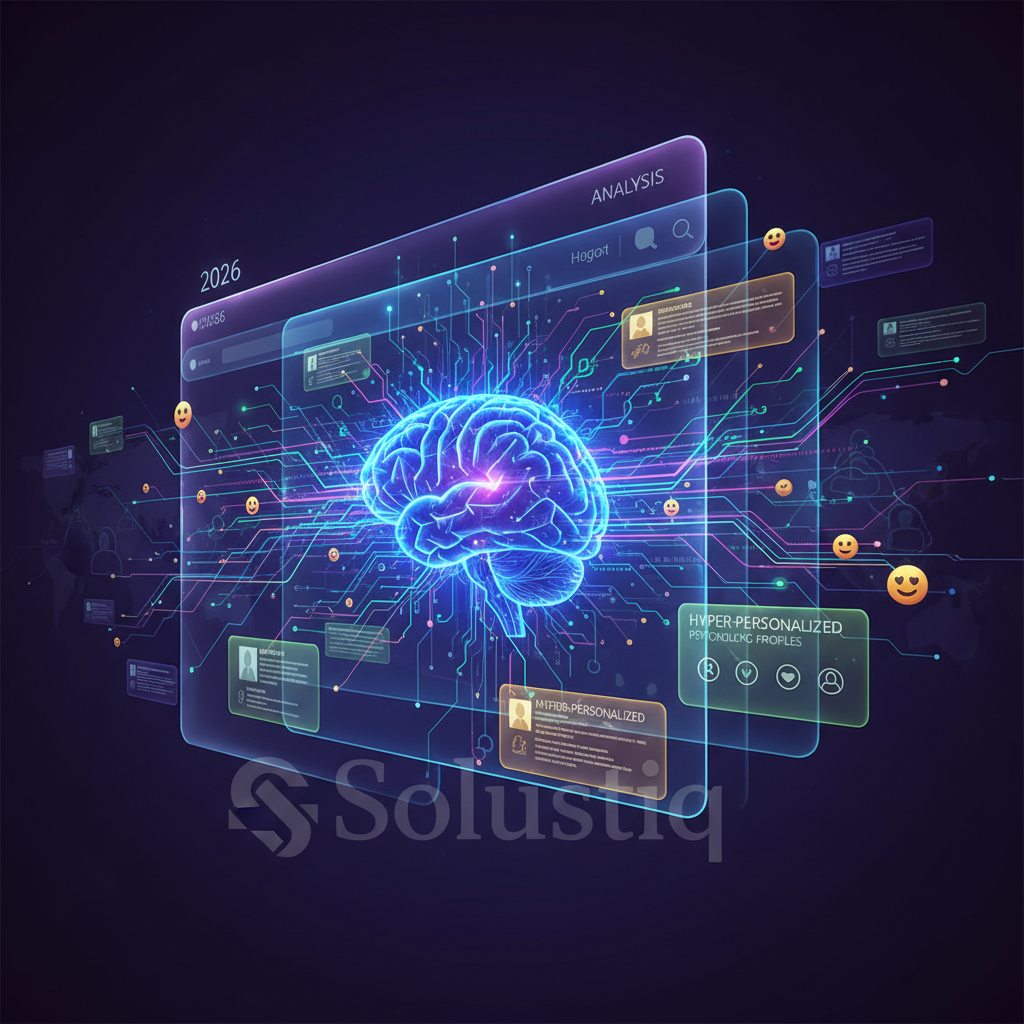
In 2026, content generation no longer focuses on addressing general target audiences. Instead, it targets the specific needs and preferences of each individual. Crucially, AI psycholinguistic analysis forms the basis of this hyper-personalized content strategy. At Solustiq, by analyzing users' linguistic signatures, we produce blog posts, product descriptions, email marketing campaigns, and website texts specifically designed for them.
This means content that is emotionally resonant, persuasive, and engagement-boosting, beyond merely creating text using keywords. For example, if a user employs anxious and information-seeking language, they are provided with more explanatory, reassuring, and detailed content. If the user uses more experience-oriented language, storytelling elements and inspiring features of the content are brought to the forefront. This ensures that the content is not only read but also evokes a genuine emotion in the user. This innovative approach is key to achieving immersive storytelling and virtual replicas in AI-powered websites, all thanks to advanced AI psycholinguistic analysis.
Personalized Content Strategies with Psycholinguistics
Solustiq employs several strategies for truly personalized content.
- Emotion-Driven Titles: Titles and slogans are dynamically created to be appropriate to the user's detected emotional state.
- Smart Text Generation: Text blocks are automatically generated or optimized based on the user's past interactions and psycholinguistic profile.
- Dynamic Content Adaptation: Website content is instantaneously adapted according to the user's linguistic and cognitive preferences, ensuring relevance.
Groundbreaking Developments and Solustiq's Future Vision for AI Psycholinguistic Analysis
As Solustiq, as of 2026, we have achieved significant successes in the field of AI psycholinguistic analysis. Our customized AI engines can create much more comprehensive psycholinguistic profiles by analyzing not only textual data but also voice data. This opens up new horizons, especially for voice assistants and interactive web applications, enhancing user engagement.
Our future vision is to apply these analyses not only to websites but also across a wide range, from corporate communication to customer services, and from e-commerce to educational platforms. Our goal is to provide meaningful and personalized experiences that exceed user expectations at every digital touchpoint. Ultimately, this enables brands to build a real connection in the digital space. In this way, we will continue to lead the industry by taking our "data-driven and AI-driven" philosophy one step further. With continuously evolving technology, our ability to understand the complexity of human language and translate this understanding into digital experiences will continue to set Solustiq apart. For further reading on the societal implications of AI, McKinsey's insights into the state of AI provide valuable context, even for 2026 advancements in AI psycholinguistic analysis.
The Future of AI Psycholinguistic Analysis
In 2026 and beyond, the application areas of AI psycholinguistic analysis will continue to expand significantly. We anticipate significant developments, especially in the following areas:
- Instant Emotion Recognition: Real-time detection of a user's emotional changes and instantly adapting the website or application experience accordingly.
- Multilingual Psycholinguistic Analysis: Developing systems capable of simultaneously and accurately analyzing linguistic and psychological patterns across various languages.
- Use in Cybersecurity: Utilizing psycholinguistic analysis to detect potential threats, malicious language usage patterns, or fraud attempts. This will also strengthen Solustiq's commitment to data security and user protection. This also ties into our overall strategy for long-term SEO sustainability for AI-powered websites.